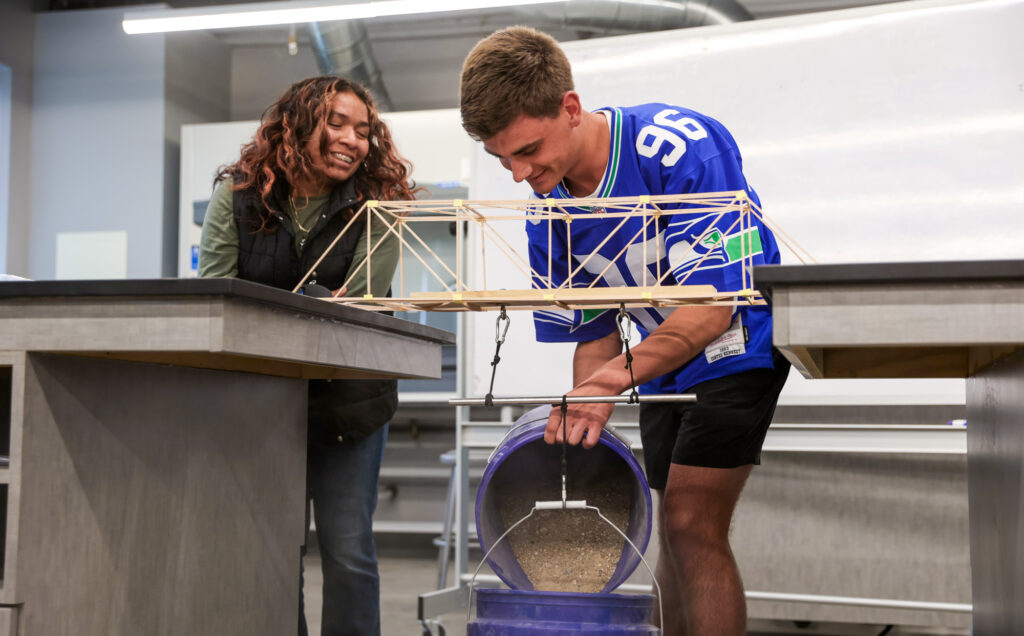
A male student in a blue football jersey pouring sand into a bucket suspended from a wooden model bridge while a female student watches.

Dual-Degree Engineering

Engineering is a hands-on career, and so is our curriculum. Your experience in project-based learning, laboratories, internships and research will prepare you for engineering school.

Dual-Degree Engineering

Dual-Degree Engineering at William Jewell

Master writing and presentation skills, critical thinking, problem-solving, then focus on a high-quality technical education to become a well-rounded engineer who can tackle global issues.

Billy J. Bird, the William Jewell College mascot, posing with wings spread open, framed in a circular cutout with campus trees and a red phone booth in the background.

Interests & Attributes:

  • Engineering
  • Science
  • Innovative

Goals for Student Learning

Students in the Dual-Degree Engineering pathway develop a strong foundation in physics, mathematics, chemistry, programming, and engineering principles. They learn to use advanced mathematics and scientific reasoning to understand and solve conceptual and analytical problems involving physical systems.

Students gain hands-on experience with laboratory techniques and experimental data. They learn to collect, analyze, and interpret data while developing an understanding of how experiments can be used to investigate physical and engineering questions.

Students also develop computational and technical skills that support modern engineering practice. Through programming and computational approaches, students learn to model physical systems and use computerized tools to investigate problems and evaluate potential solutions.

Throughout the program, students develop the ability to communicate technical ideas clearly. They learn to explain physics and engineering principles, experimental results, and conclusions in both written and oral formats while applying their knowledge to new problems and contexts.

Complete a 3+2 Program

Students begin the Dual-Degree Engineering pathway at William Jewell by completing the required coursework for the Engineering Physics major. This includes physics, chemistry, calculus, differential equations, programming, statics, and laboratory experiences, providing a broad scientific and mathematical foundation for advanced engineering study.

Engineering Physics majors may participate in a 3-2 dual-degree plan with Washington University in St. Louis, Columbia University in New York, or Missouri University of Science and Technology. Students complete the requisite coursework at Jewell before continuing their engineering education at their selected partner institution.

The pathway allows students to combine the breadth and flexibility of a liberal arts education with specialized professional engineering preparation. Students should work closely with a physics faculty advisor and the appropriate engineering program to plan their coursework and transition.

Meet Our Engineers

Josh Conner

Jewell and Vanderbilt University graduate

Josh designs ground support equipment for the Atlas V and Delta IV rocket at United Launch Alliance in Denver. Some of ULA’s rockets launch government national security satellites into orbit, send spacecraft to Mars and astronauts into space.

Erika Storvick

Pursuing mechanical engineering at Columbia University (NY)

Erika watched Blue Origin’s New Shepard space vehicle launch, and aboard was a payload she helped develop at Jewell that tested fluid flow in weightlessness. She also used a grant in Guatemala to teach Mayan youth to make solar-powered lanterns.

Beyond Jewell

The Dual-Degree Engineering pathway prepares students to continue into professional engineering study and pursue careers across a wide range of engineering disciplines. The strong foundation in physics, mathematics, computation, and problem-solving developed at Jewell can support advanced study in fields such as mechanical, civil, electrical, chemical, environmental, and other areas of engineering.

The combination of a liberal arts foundation and professional engineering education can also prepare graduates to approach technical challenges with strong communication, analytical, and interdisciplinary skills. Students can apply these abilities in engineering firms, technology companies, research organizations, government agencies, and other industries.

Engineering Faculty

Find Your Place at William Jewell