


New, non-traditional nursing programs are on the rise, and it’s now possible to obtain a bachelor’s of science in nursing in just 3 academic years. This is a perfect match for students looking to accelerate their undergraduate experience and sooner begin a career, master’s education or further specialty.
All William Jewell nursing programs prioritize the core values of a quality caretaker, such as integrity, compassion, leadership, scholarship, excellence in practice and service to others. Continue reading to learn more about what makes our 3-year nursing program unique.
How does the three-year track work?
Our 3-year nursing program comprises the same curriculum as our four-year track, including clinical rotations, but at a slightly accelerated pace. Over the course of your program you will need to complete 120 credit hours total over the fall and spring sessions, and at least one summer session. Suggested curriculum typically includes 18 credit hours per semester.
Because of the faster pace, 3-year nursing students can expect heightened course engagement and a more rigorous academic schedule. While there are abundant resources available to help you succeed, this program places an emphasis on accountability to the individual learner. This builds leadership skills and discipline that make William Jewell nursing students stand out in the career space.
Suggested curriculum
William Jewell encourages students to pursue a well-rounded education by working closely with an advisor. While the course schedule in the 3-year nursing program is rigorous, we believe in the value of extracurricular activities and pursuing interests and passions.
Our advising staff will do their best to build a personalized course schedule that meets all curriculum requirements and considers your unique interests as an individual student.
Special resources
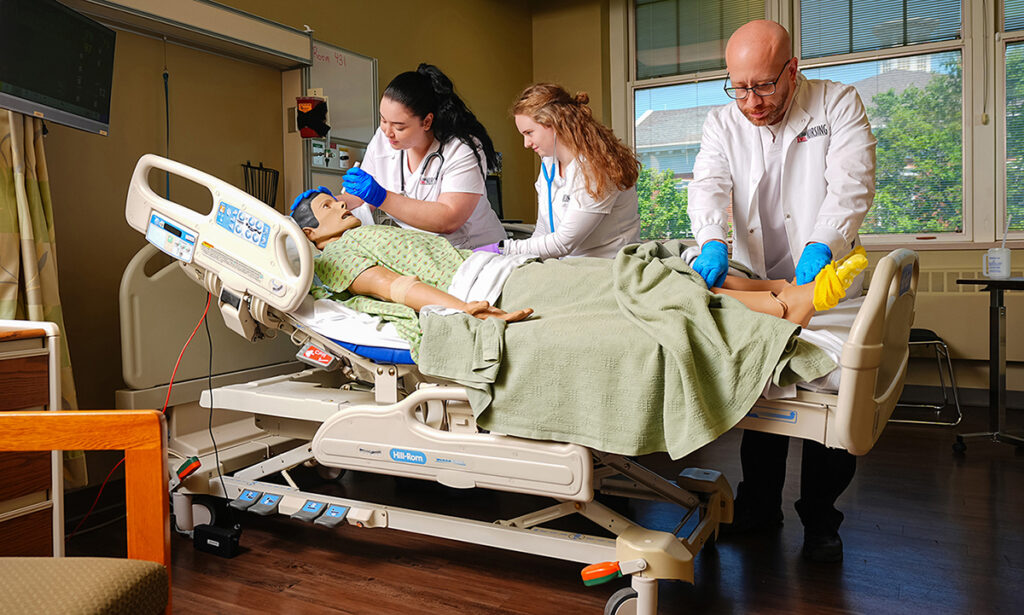
In the 3-year nursing program, you will have access to specialized academic resources like tutoring, meeting with professors and the Nursing Arts Laboratory at no additional cost to you. These resources are in place to help students maintain success in this more engaging academic program.
Responding to a need
William Jewell’s 3-year nursing program is engineered to respond to both the healthcare system’s timely increase in demand for nurses and students’ desire to finish school quicker. This specialized nursing program allows students to fast-track their undergraduate degree and sooner provide the healthcare industry with the properly equipped support it needs.
Many other nursing programs across the country are responding to these modern needs by providing online resources for nursing education, at the expense of hands-on clinical experience. It is important to note that a bachelor’s of science in nursing cannot be earned in online curriculum alone; in-person experiential learning is essential in preparing students for a nursing career.
Our 3-year program integrates critical thinking and processing skills, interpersonal experiential learning and a clinical environment to provide a well-rounded education in a shorter time frame. This is our response to the needs of our market, industry and students.
Prerequisite coursework for a 3-year nursing program
Prerequisite coursework for our 3-year nursing program is identical to our traditional 4-year undergraduate nursing program; however, the 3-year nursing program is best suited for students with AP course credits or dual enrollment course credits. General education courses like College Algebra, Composition and Reading and Introductory Psychology are suggested.
View our list of AP course credit equivalents
Three-year nursing program prerequisites checklist
- Completed William Jewell College of Nursing application or Common Application
- Copy of official high school transcripts, including GPA
- Copy of official college transcripts, including GPA (if applicable)
- Copy of ACT and/or SAT scores
To apply for the 3-year track, indicate which program you’re interested in on your Jewell application. After passing your nursing entrance exam and completing your application, you may qualify for direct admission to our 3-year undergraduate program. Requirements for direct admission are:
- Declare nursing as your major within your first semester
- ACT score of 22 or better
- Cumulative GPA of 3.0 or better
- High school diploma or GED with less than 12 college credits of college-level course work other than AP and/or dual credit obtained while in high school
- Any college level prerequisite courses must be C or better
The benefit to direct admission versus general admission is that you may begin a nursing curriculum and be advised by a member of the nursing department within your first semester of college. General admission students may be advised to complete all general education curriculum before declaring their major.
Transfer students in the 3-year program
Our transfer nursing track is designed for students with previously completed coursework or partially completed degrees. Transfer students typically have equivalent to two years of credits under their belt in general education courses like anatomy, biology, chemistry and others.
Depending on the program you’re transferring from and how many credit hours you have, you may be folded into either the current four-year or three-year class. Our goal is always to match you with other students at a similar point in their curriculum, not to make you start over or separate you from other undergraduate nursing programs.
Advantages of a slightly accelerated program
Whatever your needs or goals are as a student, our advising staff at William Jewell is committed to presenting you with the best options for obtaining your BSN degree. There are many advantageous reasons to pursue a 3-year nursing program over a traditional track.
Accelerated path to a career
Earning your degree in 3 years allows you to join the nursing workforce and begin your career sooner than traditional nursing students.
Completing an accelerated program also demonstrates excellent work ethic and time management to hospitals, clinics and practices looking to hire nurses.
More ideal for students pursuing graduate programs
If you’re planning to continue your education with a masters program or additional specialty, you may want to fast-track your undergraduate degree. Many nursing students choose to pursue a masters in nursing after completing their BSN in order to become an APRN.
An Advanced Practice Registered Nurse (APRN), is a registered nurse with specialized education in a specific patient population, type of condition or care skill set. The minimum requirements to become an APRN are:
- An RN license (obtained by completing your BSN and passing the NCLEX)
- Clinical experience in a chosen specialty
- A master’s degree in nursing (which typically takes between 18 months and three years to complete)
After becoming an APRN, there are four ways to specialize:
- Nurse Practitioner (NP)
- Certified Nurse Midwife (CNM)
- Clinical Nurse Specialist (CNS)
- Certified Registered Nurse Anesthetist (CRNA)
Completing your Bachelor’s of Science in Nursing (BSN) in three years as opposed to four or more means one less year of schooling for students who plan to become an APRN, NP, CNM, CNS or CRNA.
Doesn’t sacrifice experiential learning
Many other avenues of accelerated learning happen online. While other nursing programs may offer virtual learning, you cannot become a nurse with 100% online learning; in-person clinical experience is essential.
Most William Jewell students can complete clinical rotations in 8-10 different locations. The goal is always to afford you the most experience possible in the widest variety of specialties. Unlike other programs, you will also be able to work in highly specialized medical facilities such as pediatric centers, rural hospitals and level 1 trauma centers.
While virtual or remote learning may be suitable for a number of career fields, nursing requires hands-on experience. Our three-year program is specially designed to respond to students’ desire for an accelerated timeline and the nursing community’s need for additional, quality staff without sacrificing experiential learning.
Maintain all the benefits of a Jewell education
Although accelerated, our 3-year nursing program students maintain all of the benefits and experiences of our standard undergraduate nursing students.
Exceptional faculty
Over 75% of our classroom instructors are practicing nurses. We highly focus our curriculum on professionalism and practical applications from the start of your undergraduate nursing education.
Additionally, many of our counseling and administrative staff members are also retired or currently practicing nurses as well, including the chairmen of the department. This means that people with direct experience will provide guidance and mentorship.
The William Jewell nursing program maintains relationships with healthcare providers in the following areas of care:
- Hospitals
- Home health
- Public schools
- County health
- Senior care
- Mental health
Service and leadership opportunities
Part of being a well-rounded nurse and caregiver is giving back; in our 3-year nursing program, this starts with our William Jewell community. Nursing students are encouraged to participate in student-led service projects throughout their undergraduate program. These include blood drives, fundraisers, food drives and more.
As you move into junior and senior-level coursework, you will also have the opportunity to lead some of these service projects for your peers to donate their time and resources.
Campus involvement
Our nursing students are William Jewell students first. Our program encourages you to live on campus and participate in campus activities.
Extracurricular activities at William Jewell will help you become a more well-rounded student, individual and caregiver, including:
- Greek Life
- Vocal and Band Ensembles
- Athletics
- Multicultural Clubs
- Student Government
- And more
Becoming a registered nurse after a 3-year nursing program
The final step to becoming a registered nurse (RN) after any undergraduate nursing program is to take and pass an exam called the National Council Licensure Examination for Registered Nurses (NCLEX-RN).
The NCLEX exam uses computer adaptive testing (CAT). This style of virtual testing provides a more accurate and valuable measurement of a candidate’s true ability by reducing the number of “easy” or “difficult” items as the test continues. Essentially, the test is being optimized to your ability level as it continues.
While you can sit for the NCLEX-RN and work as a registered nurse with just an associate’s degree, earning your BSN affords you an advantage in the hiring market. Additionally, those with BSNs also earn higher pay and have more opportunities for leadership and management. Many states also require that you earn a BSN degree within 10 years of becoming an RN if you pass the NCLEX exam without it.
Apply to Our 3-Year Nursing Program Now
Is our 3-year nursing program checking all of your boxes? Apply now and start the journey to your BSN degree or contact us to connect with an advisor.